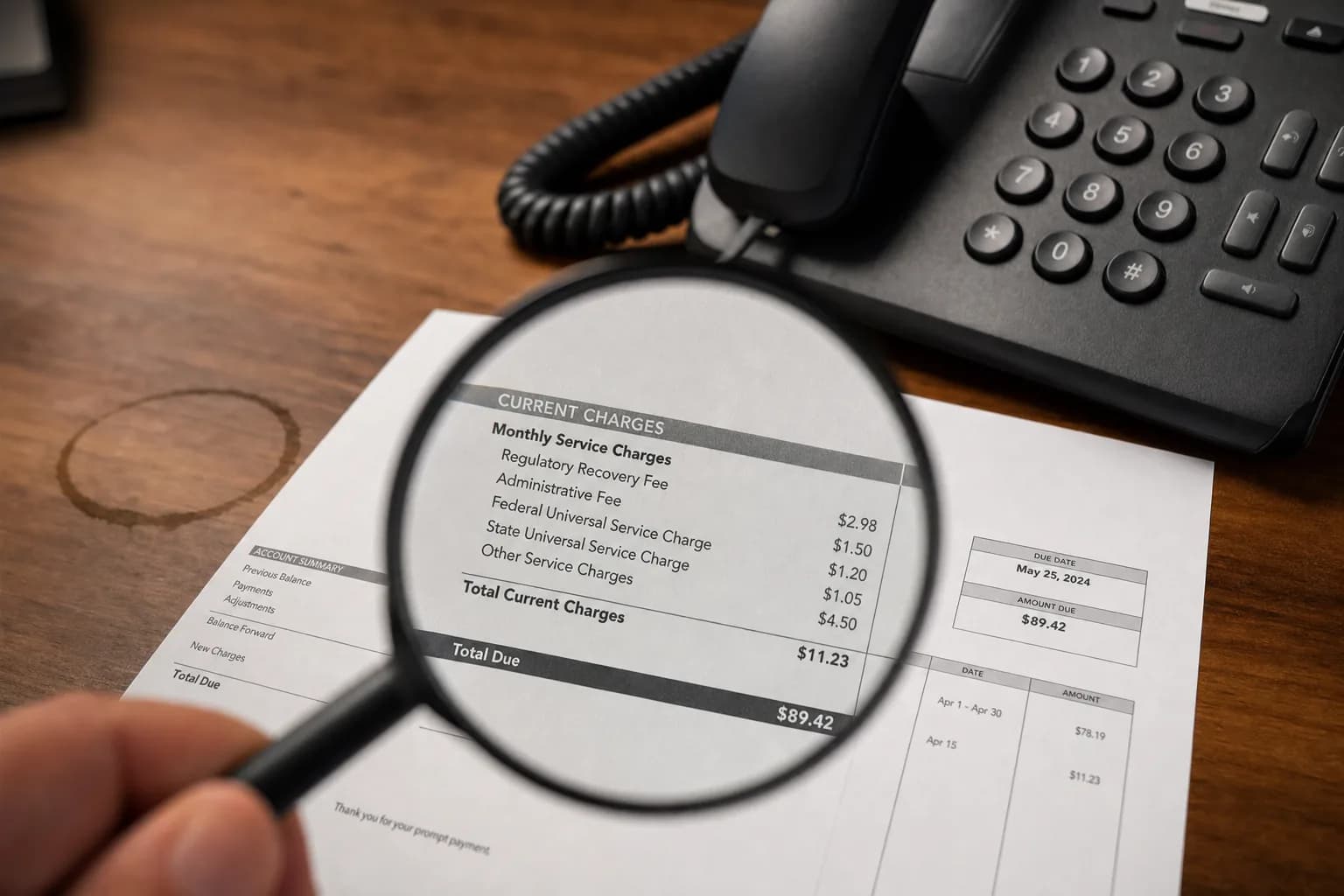
What hidden fees do VoIP providers charge?
VoIP providers commonly add six charges the quote never shows: a regulatory recovery fee, an E911 service fee, a Universal Service Fund pass-through, per line SMS charges, setup or activation fees, and early termination fees. Most are not taxes. The providers' own legal pages say so. Stacked together, they explain why a $100 quote can arrive as a $134.36 first invoice.
$134.36
Monthly bill on a $100 quote, per a BBB complaint about RingCentral: a 34 percent gap between quote and invoice
That number comes from the complaint record. In a BBB complaint about RingCentral, as of August 2026, a customer quoted $100 per month was billed $134.36. The extras included a $4.99 per line fee, a $1.50 per month SMS charge per line, and an unexplained $24 that, per the complaint, nobody at the company could explain. Customer complaints about 8x8 describe stacked gaps of 40 to 80 percent over the quote. For what a fair bill looks like, see our business phone system cost guide.
- Regulatory recovery fee: the provider's own charge, not a tax
- E911 service fee: often stacked on top of the real state 911 tax
- USF pass-through: the one genuinely federal item, reset every quarter
- Per line SMS charges: texting billed separately from the plan
- Setup and activation fees: one-time charges at the start
- Early termination fees: the exit trap, sometimes hundreds of dollars
Is the regulatory recovery fee a real tax?
No, the regulatory recovery fee is not a tax. It is a charge the provider invented to recoup its own compliance costs. No government requires it, and no government receives it. RingCentral's legal page states, as of August 2026, that the fee "is not a tax, nor is it mandated by any level of government or government agency." The money goes to the provider.
- Nextiva charges a Regulatory Recovery Fee of $3.95 per line ($0.99 for virtual numbers). Its tax rates page calls it "not a tax or charge assessed by any governmental agency," as of August 2026.
- Vonage calls its version the RCIP Fee: $3.50 per extension on business accounts. Its support page says it is "not a government-mandated fee" and applies even to tax-exempt accounts, as of August 2026.
- RingCentral names its version the Compliance and Administrative Cost Recovery Fee, disclosed on its own legal page as not government mandated.
Read the Vonage line again. A fee that applies even to tax-exempt accounts was never a tax. It is provider revenue wearing a regulatory costume. If these fees have you shopping around, our RingCentral alternative and Nextiva alternative guides show what to check before you move.
What is the E911 fee on my VoIP bill?
The E911 line on a VoIP bill often hides two separate charges under one name. The first is a real state or local 911 tax, roughly $0.20 to $2.00 per line per month depending on your state, per Nextiva's published fee explainer as of August 2026. The second is the provider's own emergency service fee stacked on top. Only the first one is required by law.
The providers admit the second layer in their own documents. RingCentral's E911 cost recovery page states, as of August 2026, that its fee "is not a government-mandated charge." Nextiva lists its E911 fee at $1.50 per line and labels it "not a tax" on its published tax rates page.
One line, two charges
Ask your provider to split the E911 line into the state 911 tax and their own service fee. If they will not split it, assume both are in there.
What is the Universal Service Fund charge on my phone bill?
The Universal Service Fund charge is the one genuinely federal item on a VoIP bill. The FCC funds phone and internet access for rural areas, schools, and libraries through the USF. Providers pay into the fund and may pass their contribution through to you at cost. That part is legal and common. The catch is the rate: it resets every quarter, and it has been climbing.
38.8%
Federal USF contribution factor for Q3 2026, the highest on record, per FCC Public Notice DA 26-546. One year earlier it was 36.0 percent, per USAC's quarterly table.
That 38.8 percent does not hit your whole bill. Under USAC's safe harbor rules, VoIP providers may treat 64.9 percent of your charges as interstate. Put the two together and a full pass-through works out to roughly 25 percent of the affected charges. That is a derived figure: 64.9 percent times 38.8 percent is about 25.2 percent.
Two things to remember. USF pass-through at cost is not a scam. But provider invented fees love to sit next to the USF line, because the neighborhood makes them look official.
Do VoIP providers charge extra for texting?
Yes, some VoIP providers charge extra for texting, billed as its own per line item even when the sales pitch sounded all-inclusive. In the BBB complaint above, the customer found a $1.50 per month SMS charge per line on a bill they believed covered everything. Ask three questions in writing: Is SMS included in my plan price? Is it billed per line or per message? Does the price change at renewal?
What about setup fees and early termination fees?
Watch both ends of the contract. Setup, activation, and implementation fees appear once, at the start. The worst documented surprise sits at the exit. In November 2022, the FTC ordered Vonage to pay $100 million in refunds over junk fees and dark patterns. Per the FTC's press release, early termination fees ran "in the hundreds of dollars" and were not clearly disclosed at signup, and some customers kept getting billed after they cancelled. Refunds later went to 389,106 consumers.
The $0.00 trap
A $0.00 line item is not always free. BBB complaints about Nextiva describe $0.00 items that convert to paid charges after 30 days unless the customer cancels them. On your first invoice, treat every $0.00 line as a question, not a gift.
Which charges are real taxes and which did the provider invent?
Sort every line on a VoIP invoice into three buckets: real government taxes, federal program pass-throughs, and provider invented fees. Only the first bucket is required by law. The second is legal and passed through at cost. The third is pure provider revenue with an official sounding name, and it is the bucket that grows.
| Bucket | What belongs here | Who gets the money |
|---|---|---|
| 1. Real government taxes | Sales tax, state and local 911 tax, state USF | Your state and local government |
| 2. Federal pass-throughs | Federal USF contribution (38.8% factor, Q3 2026) | The FCC's Universal Service Fund |
| 3. Provider invented fees | Regulatory recovery, RCIP, compliance, administrative, E911 "service fee," setup, paper bill | The provider |
Five red flags to circle on any quote or contract:
- A footnote that says "taxes and fees not included"
- Any $0.00 line item
- The phrase "fees subject to change"
- Auto-renew terms buried in the terms of service
- Any fee name containing "recovery," "compliance," or "administrative"
Auto-renew clauses do the most quiet damage, because fees jump at renewal time. Our VoIP contract renewal checklist walks through what to check 60 days before your term rolls over.
Tired of decoding invoices? Business Phone System quotes one flat price per user, month to month, with no fee stacking. The number on the quote is the number on your card statement.
Get a flat quote