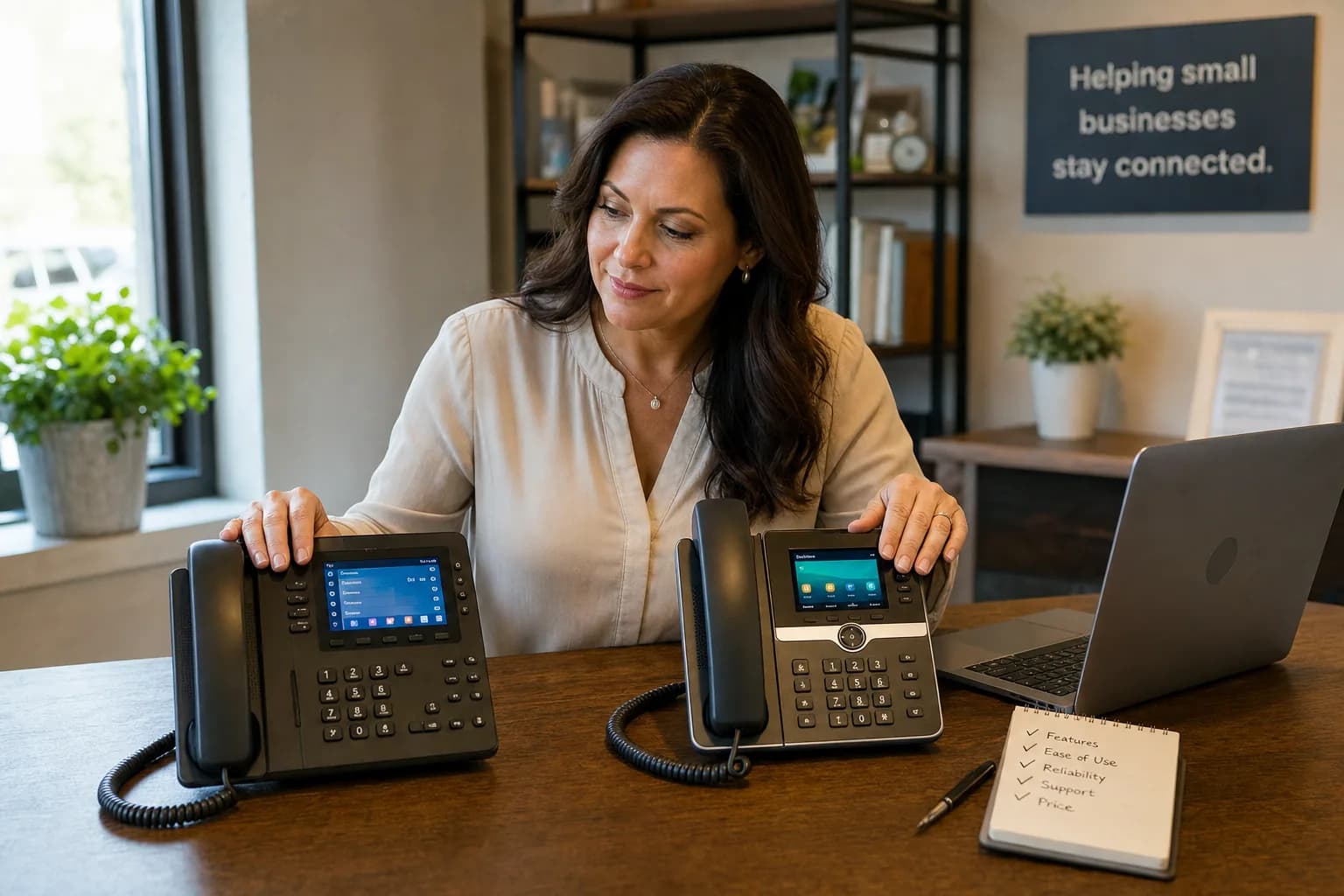
What is the best phone system for a small business?
The best phone system for a small business is a cloud phone system with no long term contract, one flat quoted price, free help porting your number, registered business texting, proper 911 setup, and apps that work on any phone or computer. For most teams of 1 to 50 people, that means cloud VoIP, not a landline and not an on-site phone server.
"Best" is not about the longest feature list. It is about seven things that actually matter to an owner or office manager:
- 1You keep your number. Porting is a federal right. The FCC says your old company cannot refuse to move it, even if you owe them money.
- 2Your texts actually deliver. Business texting from a regular local number now requires registration. Skip it and carriers filter or block your messages.
- 3No contract traps. Month-to-month billing, plain pricing, and a cancel process you can actually use.
- 4911 works right. The law requires direct 911 dialing and an address that reaches dispatchers. You still have to check your setup.
- 5Apps on every device. Your team should answer the business line from a desk phone, a cell phone, or a laptop.
- 6A human answers support. When phones are down, a ticket queue is not good enough.
- 7A price that matches the quote. The advertised price and the billed price are often not the same. More on that below.
Everything in this guide feeds those seven checks. If you want the short version of what to buy, start with our phone system for small business overview, then come back for the traps.
VoIP vs landline vs virtual number apps: which type fits you?
There are three kinds of small business phone systems. Cloud VoIP runs your calls over the internet and fits most teams. An on-site PBX is a phone server in your building, and it only makes sense in rare cases. Virtual number apps like Google Voice add a work number to your existing cell phone, which works for solo owners but gets thin fast.
| System type | Typical cost | Best for | Watch out for |
|---|---|---|---|
| Cloud VoIP (hosted phone system) | $10 to $40 per user per month (industry surveys, as of August 2026) | Most teams, 1 to 50+ people | Fee stacking, SMS caps, annual contracts |
| On-site PBX (phone server in your office) | Around $20,000 upfront for a 15 to 20 person team, per GetVoIP industry estimates, vs under $2,000 to start hosted | Special needs: old analog gear, no reliable internet, strict compliance rules | You maintain it. You need IT help. Upgrades cost real money |
| Virtual number apps (Google Voice class) | $10, $20, or $30 per user per month plus required Google Workspace, per Google's official pricing page | Solo owners and tiny teams | Thin call handling. Auto attendants and call queues cost extra or sit in higher tiers |
- Google Voice needs Workspace. Google's own page says Workspace is required, so the real starting price is about $17 per user once you add Workspace Starter. Auto attendants require the $20 Standard tier. Automatic call recording and ring groups with queueing sit in the $30 Premier tier, per Google's page as of August 2026.
- You almost certainly do not need an on-site PBX. Auto attendants, ring groups, call queues, and recording are standard cloud features now. Small teams paying $20,000 for a closet full of hardware are paying for a 2005 problem.
For deeper side-by-side breakdowns, see VoIP vs landline and PBX vs VoIP.
How much does a business phone system cost per month?
Most small businesses pay $10 to $40 per user per month for a cloud phone system, based on industry pricing surveys as of August 2026. Traditional landlines run $50 to $100 or more per line per month. Virtual number apps start near $10 per user but require add-ons. The number to watch is the gap between the advertised annual price and what you actually pay month to month.
- RingCentral RingEX: Core is $20 per user per month billed annually, or $30 billed monthly. Advanced runs $25/$35 and Ultra $35/$45, per RingCentral's pricing page as of August 2026. Paying monthly can cost up to 50 percent more than the advertised annual number. Add-ons are extra, including an AI receptionist from $39 and an SMS booster at $25. Multiple industry sources also report Core includes only about 25 texts per user per month.
- Zoom Phone: metered US and Canada calling runs about $10 per user per month, unlimited about $15, and the global plan about $20, per Zoom's pricing structure and 2026 industry reporting. Metered outbound calls cost about 3 cents per minute.
- Google Voice: $10, $20, or $30 per user per month, plus required Google Workspace, per Google's official page as of August 2026.
Then there is the bill itself. Advertised prices rarely include taxes, regulatory recovery fees, E911 fees, and surcharges. Those can add a meaningful chunk to every line, every month. Ask every provider the same question: what is the all-in monthly number after every fee? If they cannot answer in writing, that tells you something. Our business phone system cost guide walks the full math.
Tired of doing tax and fee math on a "$20" phone plan? Business Phone System quotes one flat price up front, with no fee stacking and no long term contract. Compare it to your current bill.
Call for a flat quoteHow do I switch business phone providers without losing my number?
Sign up with the new provider first and ask them to port your number. Do not cancel your old service until the port is complete. Porting is a federal right: the FCC says your old company cannot refuse to move your number, even if you owe them money. Simple ports must complete in one business day under FCC rules.
- 1
Pick the new provider and start service
The new provider files the port request for you. You do not ask your old company for permission.
- 2
Keep your old line active
The FCC explicitly warns that canceling first can cost you the number. This is the single most common switching mistake.
- 3
Wait for the port to complete
Simple ports, meaning a single line with no complex changes, must process in one business day under FCC rules. Moving a wireline number to a wireless service can take a few days.
- 4
Then cancel the old account
Any balance you owe survives the switch. The debt stays. The number moves.
Two myths to drop
"My old provider can hold my number hostage over an unpaid bill." False, per the FCC. They cannot refuse the port. "Porting takes weeks." For a simple business line, the FCC rule is one business day. Companies may charge a porting fee, but the FCC notes you can ask for it to be waived. Some providers handle the whole port at no charge. Ask before you assume.
The full walkthrough, including what to gather before port day, is in how to switch business phone providers.
Why are my business text messages not getting delivered?
Because your number probably is not registered. Application-to-person texting from a regular 10-digit local number in the US requires A2P 10DLC registration, per Twilio's compliance documentation. Unregistered senders face extra carrier fees and heavy filtering, and industry reporting says major carriers began blocking unregistered traffic outright in February 2025. Registration ties your business identity to your number so carriers trust your texts.
Plain-English version: if your phone system, booking tool, or CRM sends texts from your business number, US carriers want to know who you are. That happens through a registration system called A2P 10DLC, run through The Campaign Registry ecosystem. Twilio's docs state that anyone sending app-to-person SMS or MMS over a 10DLC number to the US must register, and that unregistered senders receive additional carrier fees plus tougher filtering.
- Ask who files the registration. Some providers file the brand and campaign paperwork for you. Others hand you a form and wish you luck.
- Ask what it costs and how long approval takes. Registration can take days to weeks depending on the case.
- Ask how many texts are included per user. Some entry plans cap texting at numbers as low as about 25 per user per month, per industry reporting on major providers as of 2026. If texting customers is part of your day, that cap will bite.
If your texts are already failing today, check registration first. It is rarely the phone. It is the paperwork.
Can I call 911 from a VoIP phone system?
Yes, but VoIP 911 has real limits you must set up correctly. Per the FCC's own guide, VoIP 911 calls may not route to the right dispatch center, may not send your location automatically, and may not work in a power or internet outage. You must register your address and keep it current. Federal law also requires direct 911 dialing and location delivery on newer multi-line systems.
- Kari's Law: any multi-line phone system sold or installed after February 16, 2020 must let anyone dial 911 directly, no "dial 9 first," and must notify someone on site, like a front desk, when a 911 call is made.
- RAY BAUM'S Act: the same systems must send a dispatchable location to the 911 center. That means street address plus floor or suite, not just a company name. The FCC's multi-line system requirements page reflects these rules as of its January 2026 update.
- 1Register the correct street address for every line and every user, including remote workers.
- 2Update the address when anyone moves. A softphone that travels with a laptop needs its location kept current.
- 3Ask the provider how each user's 911 location gets set and changed, and who is responsible.
- 4Have a backup for outages. The FCC guide is blunt: VoIP may not work during a power outage or when the internet fails. A mobile app on a cell phone is your natural fallback, since the cell network stays up when your office internet does not.
Do not let a salesperson wave this off. Ask the 911 question directly and listen for a specific answer.
Is a landline still the safe choice for a business?
No. The copper landline network is being retired. FCC data as of June 30, 2025 shows only 15 million traditional copper lines left nationwide against 63.4 million VoIP subscriptions, with copper shrinking about 17.9 percent per year. AT&T has said it plans to exit legacy copper across most of its footprint by the end of 2029.
83.6%
of US business wireline voice connections are already VoIP, about 43.97 million VoIP versus 8.6 million copper, per the FCC Voice Telephone Services report published May 2026
15 million
copper end-user lines left in the entire country, declining at a 17.9 percent compound annual rate from 2022 to 2025, per the same FCC report
And the biggest carrier is heading for the exit. AT&T has stated it is actively working to leave legacy copper across the large majority of its wireline footprint by the end of 2029, and that fewer than 3 percent of its voice customers still use copper, per AT&T statements reported by AARP.
So "just keep the landline" is not the cautious move. It is the expensive move now, at $50 to $100 or more per line per month per industry surveys, and the risky move later, when your carrier retires the line on its own schedule, not yours. Switching while you have time to port your number calmly beats switching during a forced migration.
10 questions to ask any phone provider before you sign
Ask every provider the same ten questions and get the answers in writing. The questions cover contract terms, the true all-in price, auto-renewal, cancellation, texting registration, number porting, 911 setup, internet outages, and support. A provider that answers all ten plainly is safe. A provider that dodges any of them just answered anyway.
- 1Is this month-to-month? What exactly changes if I decline the annual price?
- 2What is the all-in per-user price after taxes, regulatory recovery fees, E911 fees, and surcharges?
- 3Does the agreement auto-renew? Into what term, and how many days notice do I need to cancel?
- 4What is the early termination fee formula, in writing?
- 5Can I cancel the same way I signed up, or only through a phone retention line? Call this the Vonage test.
- 6Who files my A2P 10DLC texting registration, what does it cost, and how many texts per user are included?
- 7What is your porting process, fee, and timeline? Do I keep service on my old number until the port completes?
- 8How do you meet Kari's Law and RAY BAUM'S Act? Can each user's 911 location be set and updated?
- 9What happens to my calls when my internet is down? Is there automatic failover to the mobile app or a cell number?
- 10Is live human support included at my tier, and during what hours?
Print this list. Ten minutes on the phone with it will save you from every trap in this guide.
What phone system does not lock you in?
A phone system with no lock-in bills month to month, quotes one flat price with every fee included, lets you cancel the same way you signed up, stops billing when you leave, and ports your number in and out freely. Any provider can claim this. The proof is in the contract terms and the answers to the ten questions above.
What is the best VoIP for a small business with no contract?
The best no-contract VoIP is whichever cloud phone system passes all ten questions in writing: month-to-month billing, one all-in quoted price, free porting in and out, filed texting registration, and a cancel process as easy as signup. Measure any provider against this list rather than against ads.
- Month-to-month billing. No 1 to 3 year term hiding behind the discount price.
- One flat quoted price. The number on the quote is the number on the bill.
- Billing stops when you leave. No "remaining months times monthly fee" math. No hardware clawbacks.
- Porting handled for you. In when you arrive, out if you ever go. Your number is yours either way, and federal rules back you up.
- A human answers support. During stated business hours, a person, not a ticket bot.
This is the standard Business Phone System was built on: no long term contracts, one flat quoted price with no fee stacking, porting handled for you, billing that stops when you leave, and a real person answering support calls. It includes desk phones, cordless handsets, a mobile app, a desktop app for calls and texts from a computer, business texting, voicemail to email, auto attendants, ring groups, and an SMS API for connecting your CRM.
Want a phone system that passes all ten questions? Month to month, one price, your number ported for you, and a real person on the support line. If it is not a fit, you learned exactly what to demand from whoever you pick instead.
Get your flat quote from Business Phone System