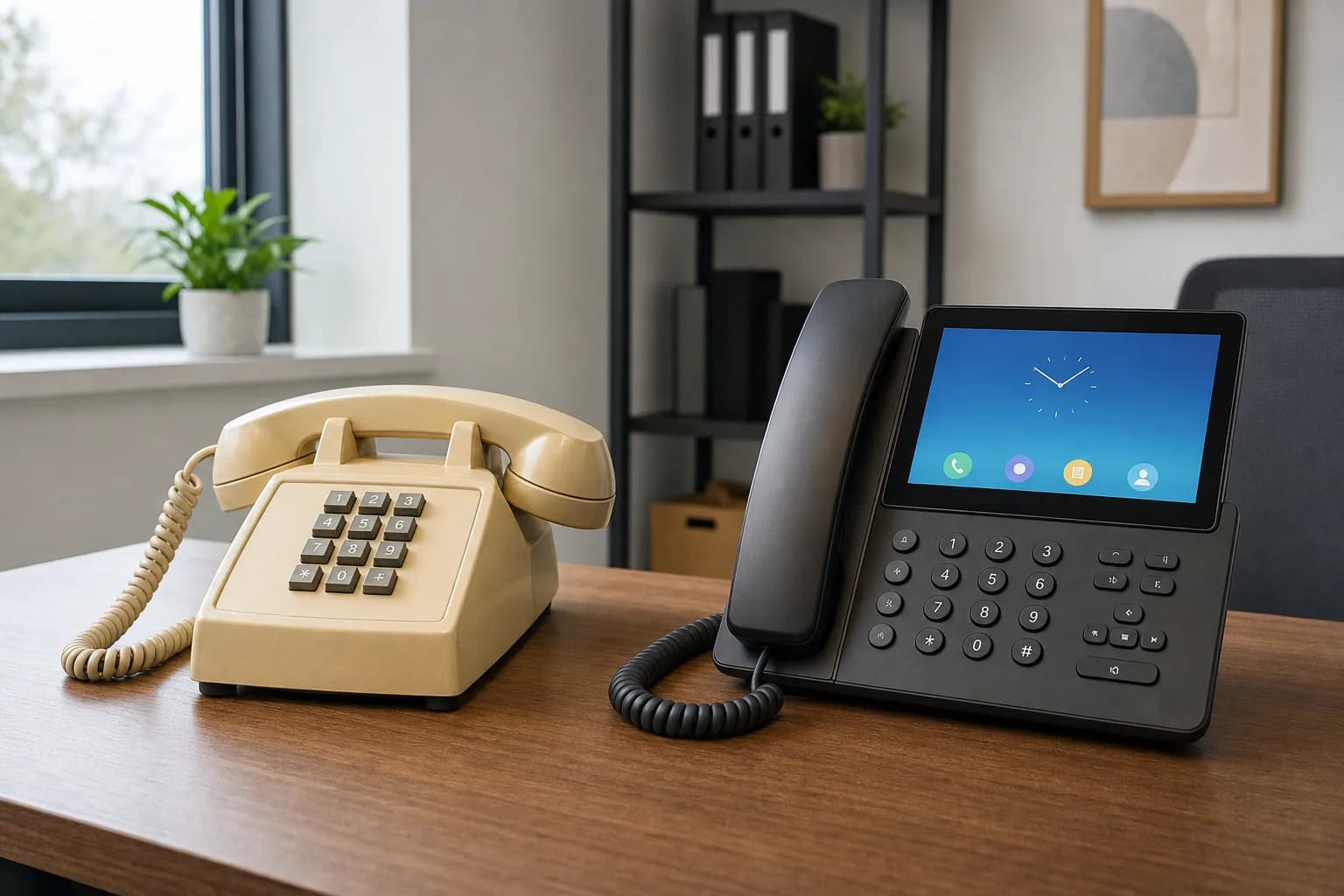
What is the difference between VoIP and a landline?
A landline carries your voice over a dedicated copper wire that runs from the phone company's office to a jack in your wall. VoIP carries your calls as data over the internet your office already pays for. The practical difference is where the number lives. A landline number is tied to one wall jack. A VoIP number lives in the cloud and rings your desk phone, computer, and cell phone at once.
Landline service is often called POTS, which stands for plain old telephone service. It is the same basic technology your grandparents used. The copper wire itself carries a small electric charge, which is why an old corded phone still works when the power goes out.
VoIP stands for voice over internet protocol. Ignore the acronym. It just means your calls travel over the internet instead of a copper wire. You can use real desk phones, a cordless handset, an app on your cell phone, or an app on your computer. To a caller, it sounds and works like any other phone call. If your office has an old phone box in a closet, that is a PBX, and our PBX vs VoIP guide covers that comparison.
The choice used to be a real debate. It is not anymore, because one of the two options is being shut down. That is the next section.
Are landlines really going away?
Yes. Landlines are being retired right now, not someday. The FCC's own count shows only 16 million copper phone lines left in the entire US, against 64 million VoIP lines and 391 million cell phones. Copper lines are disappearing at 17.8% per year. Those numbers come from the FCC's Voice Telephone Services Report, with data through December 31, 2024, released in February 2026.
82%
of US business wireline connections are already VoIP, per the FCC Voice Telephone Services Report (data through December 2024). Only 18% still run on copper.
Here is the part most business owners have not heard. The government is no longer making phone companies keep copper alive:
- In March 2025, the FCC issued orders that streamline copper retirement and waived, for two years, the rule that carriers must offer a standalone voice replacement before shutting copper down.
- In March 2026, the FCC's Network and Services Modernization Order, per the FCC's own fact sheet, lets carriers grandfather old voice service, approves shutdown applications automatically after 31 days, and blocks state rules that would force carriers to keep copper running.
- Carriers are filing real retirement notices. An FCC public notice from January 2025 shows AT&T, through BellSouth, certifying copper retirement across multiple service areas.
Trade press reports go further. Telecompetitor and Light Reading report that AT&T stopped taking new copper orders on October 15, 2025, aims to retire most of its copper network by the end of 2029, and spends roughly $6 billion a year maintaining copper for about 5% of its customers. Treat those as reported figures, but the direction is not in doubt.
Nobody is banning landlines
The FCC simply stopped requiring carriers to maintain them. Carriers are retiring copper because almost nobody uses it and it costs a fortune to run. If your business is still on copper, the question is not whether to switch. It is whether you switch on your schedule or on the phone company's schedule.
Is VoIP cheaper than a landline?
Usually, yes, and the gap gets wider the more features you use. Industry cost guides put typical business VoIP at $15 to $30 per user per month, with the auto attendant, voicemail to email, and mobile app included. Legacy copper business lines commonly run $50 to $100 or more per line per month once features and maintenance are added, and grandfathered copper pricing keeps rising as carriers push customers off.
For a real published example: as of August 2026, Ooma's official pricing page lists business plans at $19.95, $24.95, and $29.95 per user per month, with unlimited US calling and a virtual receptionist on the base plan. Two honest warnings before you compare quotes:
- 1Taxes and fees are real. Industry cost breakdowns report that taxes and regulatory fees typically add about 15 to 25 percent on top of a VoIP sticker price. A $20 plan is not a $20 bill. Always ask for an all-in monthly number.
- 2Feature for feature is where copper loses badly. On a landline, an auto attendant, hunt groups, and extra voicemail boxes are per-feature add-ons that stack up fast. On VoIP, they are included in the base plan.
For a line by line look at what the bill will really be, see our business phone system cost guide and our breakdown of VoIP hidden fees.
Tired of guessing what the bill will actually be? Business Phone System quotes one flat monthly price up front, with no fee stacking and no long term contract. Compare it to your current phone bill and keep whichever number is smaller.
Call for a flat quoteWhat do you get with VoIP that a landline cannot do?
A landline gives you a dial tone, caller ID, and basic voicemail on the handset. That is the whole list. A modern VoIP phone system includes the tools an office actually uses: business texting from your main number, a mobile app so your number follows you, voicemail sent to your email, an auto attendant that greets and routes callers, and ring groups so one call rings several phones at once.
| Feature | Landline | VoIP |
|---|---|---|
| Dial tone and caller ID | Yes | Yes |
| Voicemail | On the handset only | Sent to your email as audio plus a transcript |
| Texting from your business number | No. Customers who text you get silence. | Yes, SMS and MMS |
| Works outside the building | No | Yes, mobile and desktop apps |
| Auto attendant (press 1 for...) | Paid add-on, if offered | Included |
| Ring groups (one call rings many phones) | Paid add-on, if offered | Included |
| Call recording and call reports | Rare | Common |
| Connects to your CRM or other tools | No | Yes, on many systems |
The texting row deserves a second look. A growing share of customers text a business number before they ever call it. On copper, those texts vanish. No error message, no bounce. The customer just thinks you ignored them.
Which is more reliable, VoIP or a landline?
Reliability depends on what fails. In a power outage, a corded phone on a copper landline keeps working, because the wire itself carries power. That is copper's one remaining advantage, and it is shrinking: the FCC's own orders describe the copper network as aging and deteriorating, and carriers have stopped investing in repairs. VoIP needs internet and power at your building, but your number does not go dead when either one drops.
Here is why. A VoIP number lives in the cloud, not in your building. If your internet goes out:
- Calls automatically forward to a cell phone. You set this failover once in the app, in about two minutes.
- Your auto attendant and voicemail still answer, because they run in the cloud.
- Your staff can keep making and taking calls from the mobile app on cellular data.
A copper line has no backup plan. If the wire is cut or the equipment at the phone company fails, your number is simply dead until a technician shows up, and repair times on the aging network are stretching. Two safety points every owner should know:
- 911 works on VoIP, with one duty on your side. Federal rules (47 CFR Part 9) require VoIP providers to deliver 911 calls using your Registered Location, the address on file for your device. Keep that address current, especially if you move a desk phone.
- Backup power is your job now. FCC rules (47 CFR Part 12) require providers of fixed phone service that is not line-powered to offer at least 8 hours of backup power, with a 24-hour option. For a business, a small battery backup on your internet router covers the same gap for well under one month of copper service.
And on sound quality: modern VoIP on a decent connection typically sounds better than copper, not worse. HD voice carries more of the human voice than an old copper line can. When VoIP sounds bad, the culprit is almost always a weak or overloaded internet connection, not VoIP itself.
Should I keep a landline for my fire alarm, elevator phone, or fax machine?
Do not move fire alarm panels, elevator phones, or old fax machines onto regular VoIP, but do not plan to keep them on copper either. Fire alarms and elevator phones are life safety systems with their own codes, and a plain VoIP adapter usually fails inspection. The durable fix is a purpose-built cellular communicator, because the copper underneath these lines is being retired whether you act or not.
- Elevator phones. The elevator safety code (ASME A17.1) requires two-way communication, and inspectors generally want a dedicated, supervised line. The standard fix is a purpose-built cellular elevator communicator.
- Fire alarm panels. The fire alarm code (NFPA 72) requires supervised communication paths that detect their own failures. Industry sources note that a plain VoIP adapter typically fails inspection. The code-compliant path is a listed cellular or IP fire communicator, installed by your alarm company.
- Fax machines. Analog fax signals often garble over compressed VoIP. If you truly still fax, use a VoIP plan with T.38 fax support or switch to an online fax service.
- Burglar alarm dialers and rural sites with no real broadband round out the list.
Even these systems cannot keep the landline forever. The copper is going away underneath them. The answer for each one is a purpose-built replacement, not clinging to a dying wire. Talk to your alarm and elevator vendors this year, not the year the retirement notice arrives. For every other line in the building, a standard small business phone system covers the office side.
How do I switch business phone providers without losing my number?
You port your number, and the law is on your side. FCC number portability rules give you the right to take your phone number to a new provider, and your old provider cannot refuse, even if you owe them money or are mid-contract. The number your customers know moves with you. Do not cancel the old service first. Sign up with the new provider, and they submit the port.
- 1
Pick the new provider and sign up
Your number ports in behind the scenes. You do not need to call your old carrier at all.
- 2
Do not cancel your old service yet
Canceling first can release the number. The port itself closes out the old line.
- 3
Have a recent phone bill handy
The new provider needs the account number and service address exactly as the old carrier has them. Mismatches are the top cause of port delays.
- 4
Keep taking calls
Your old line works normally until the moment the port completes.
- 5
Plug in and go
Desk phones arrive ready to use, and the mobile app works the same day.
Downtime during a clean port is typically minutes, not days. The most common snag is a mismatch between the bill and the port form, which is why the recent bill matters. For the full checklist, see our step by step guide to switching business phone providers.
Want it handled for you? Business Phone System manages the entire port, so your number moves without you chasing your old carrier. Month to month, no long term contract, one flat quoted price, and a real person answers when you call support.
Get a port date and a flat quote